

Classic LA Operation
The Classic Re-configuration Rules
The basic rules of LA, The Classic Rules, which cause isolation and reconfiguration are as follows:
-
A Feeder device trips when there is no supply.
-
A Mid-Point device changes to the alternate Protection Group and changes to single-shot mode for a short time if there is no supply.
-
A Tie device closes when it detects that supply to one side of the network is not available providing supply is available on the other side.
These simple rules can isolate and reconfigure the network for all possible faults detected.
Classic Isolation and Re-Configuration Example
Consider the basic LA scheme depicted below that consists of two
Feeder devices, One Mid-Point and one Tie device creating five sections
of feeder A – E.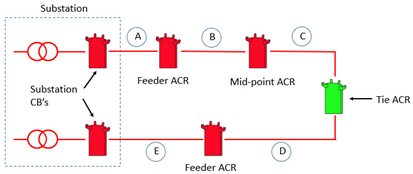
With Classic LA enabled, a fault in Section B would initiate the following sequence.
-
Overcurrent protection trips the Feeder ACR upstream from the fault. Note that this just a normal protection operation, not a LA function.

-
The feeder ACR may trip and auto reclose a number of times in anticipation of the fault clearing. When the auto reclose sequence has finished and the ACR has gone to lockout, section B (faulted) and section C (un-faulted) are both without supply. LA then changes the Mid-Point ACR to the alternate (reverse) protection group and turns Auto Reclose Off temporarily according to RULE B.

-
LA then closes the Tie ACR according to RULE C
.
-
The Mid-Point ACR trips due to protection when the fault in section B is reenergized and goes directly to Lockout.

-
This action isolates section B and reconfigures the network to provide supply to section C.
Fault Detected in Section A – Classic LA
In this scenario, the circuit breaker at the substation trips and source supply is lost to the Feeder ACR between sections A and B which then trips according to RULE A. The Mid-Point ACR between sections B and C also loses supply on its source side causing it to change to the alternate protection group and go to single shot mode according to RULE B.
Similarly, supply is also lost to one side of the Tie ACR which now closes according to RULE C, and restores supply to the un-faulted B and C sections.
Fault Detected in Section C – Classic LA
A fault in section C would cause the Mid-Point ACR closest to the Tie to trip. This would cause a loss of supply on one side of the Tie which would then close onto the fault according to RULE C. The Tie ACR would have set single shot mode before it closed so would have gone to lockout when it tripped.
Faults Detected in Sections D and E
These are similar to faults in sections A and C and are isolated and reconfigured in a similar manner.
The Classic Restoration Rules
The process of isolating the detected fault and reconfiguring the network to bring supply back to the fault free section is the primary function of LA.
In addition, LA can Auto-Restore the original network configuration when the detected fault on section B in the example above is removed. The basic rules for restoration are:
D. A Mid-Point ACR closes when supply is restored to both sides.
E. The Tie ACR trips when power flow reduces by 50% or power flow direction through the switchgear reverses.
F. The Feeder ACR closes when its source supply is restored, providing it was tripped by LA, or when supply is restored on both sides.
Classic Auto Restore Example
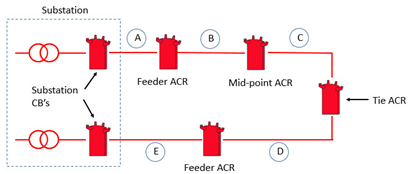
The restoration
process starts when the fault is removed and one of the open ACRs
is manually closed. In this example the Feeder ACR is manually closed.
-
The Mid-Point ACR detects that supply is present on both sides and closes according to RULE D.
-
Section C is now fed through the Mid-Point as well as the Tie ACR which causes the Tie ACR to open according to RULE E.
